LIR RESPATI BUMIDAYA
Agnostics
Fence-sitters.
Agnostics claim that they simply do not know whether or not god(s) exists. It has not been proven, and it has not been disproven. Therefore, neutrality seems like the most rational option.
On the face of it.
But let's look a little deeper, shall we? Follow me into the abyss...
As usual, people apply different rules of logic and rationality to religion.
No. You keep your disbelief, your default position of not believing things without evidence to the contrary.
Do you believe there is such a thing as an invisible unicorn? No. Are you.. agnostic with respect to this unicorn? Likely not. If you are honest with yourself, you tend to simply dismiss the claim and move on with your life.
Would this change if millions of people believed in the invisible unicorn?

There is, however, a circumstance in which one can be technically said to be agnostic about god, or the unicorn, or faeries, or what have you.
Most people will admit that there is no definite way of knowing anything. This could all be a dream, or a computer simulation, and what we think we know could all be completely false. Gravity could not exist, our friends could not exist, trees could not exist. We don't know for absolute certain that fairies don't exist. We don't know for absolute certain that aliens haven't visited, we don't know for absolute certain than gnomes don't party in our homes while we sleep. You get the point, right?
When questioned deeply, most people will say that there is nothing that they can be 100% sure of. But there are things that they can be 90-95% sure of, and that is good enough when it comes to living one's life and articulating one's beliefs.
So, if you're the kind of agnostic who likes to admit, in daily parlance, this fundamental uncertainty about the fabric of reality, I submit that you should clarify this position, and stipulate that you are a general-agnostic. That you take this uncertainty to represent your constant state of not-knowing, in order to make clear that your agnosticism extends to every possible circumstance, not just religion.
That way, I won't have to sneer at your eternal wussy-ness. You wuss.
Agnostics claim that they simply do not know whether or not god(s) exists. It has not been proven, and it has not been disproven. Therefore, neutrality seems like the most rational option.
On the face of it.
But let's look a little deeper, shall we? Follow me into the abyss...
As usual, people apply different rules of logic and rationality to religion.
This is easily demonstrated by the use of such things as the FSM, Russell's Teapot, The Invisible Pink Unicorn, etc.
Somebody makes a claim that can neither be verified, nor disproven. Do you immediately adopt an agnostic position with regards to it? Do you immediately accept the possibility of the Flying Spaghetti Monster, just because someone suggested it?
No. You keep your disbelief, your default position of not believing things without evidence to the contrary.
Do you believe there is such a thing as an invisible unicorn? No. Are you.. agnostic with respect to this unicorn? Likely not. If you are honest with yourself, you tend to simply dismiss the claim and move on with your life.
Would this change if millions of people believed in the invisible unicorn?
Hopefully not.
Are you agnostic with respect to the thousands of gods that are now part of mythology? The Greek gods? The Egyptian gods? The pagan gods? Hundreds of thousands of people once believed in all of those, too. Are you agnostic with respect to the myriad of Hindu gods? What about the Hindu 'prophet' to whom all of Jesus' alleged miracles (and more) are attributed? He has millions of followers. Are you agnostic with regard to this living man's divinity? There are an infinite number of gods within the blanket of religion that one must be 'agnostic' about if one is to be agnostic about the judeo-christian one.
Saying you are an agnostic in the religious sense alone just means that you don't want to make a commitment. You don't want to engage in the argument, you don't want to offend anyone, you just want to sit on the fence, and survey the battle below. It's nonsense, really. It is not the 'most rational' position, and you are simply opting out of the discussion by pretending that both sides hold equal merit.
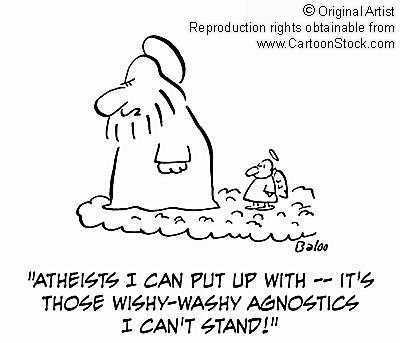
There is, however, a circumstance in which one can be technically said to be agnostic about god, or the unicorn, or faeries, or what have you.
Most people will admit that there is no definite way of knowing anything. This could all be a dream, or a computer simulation, and what we think we know could all be completely false. Gravity could not exist, our friends could not exist, trees could not exist. We don't know for absolute certain that fairies don't exist. We don't know for absolute certain that aliens haven't visited, we don't know for absolute certain than gnomes don't party in our homes while we sleep. You get the point, right?
When questioned deeply, most people will say that there is nothing that they can be 100% sure of. But there are things that they can be 90-95% sure of, and that is good enough when it comes to living one's life and articulating one's beliefs.
So, if you're the kind of agnostic who likes to admit, in daily parlance, this fundamental uncertainty about the fabric of reality, I submit that you should clarify this position, and stipulate that you are a general-agnostic. That you take this uncertainty to represent your constant state of not-knowing, in order to make clear that your agnosticism extends to every possible circumstance, not just religion.
That way, I won't have to sneer at your eternal wussy-ness. You wuss.


Tidak ada komentar:
Posting Komentar