LIR RESPATI BUMIDAYA
: Religion and Science.
I'm going to do a two or three-part post presenting my views about, and problems with religion in a cogent fashion. These thoughts have been banging around in my head since before the advent of New Atheism, and I feel it would be useful to get them down, and continue to whittle away.
So.
Religion and science.
Can the two can coexist peacefully in one mind? Something that's always puzzled me. The existence of prominent scientists who claim to be religious (Francis Collins comes to mind) seems to suggest, yes.
But should we accept this? Are science and religion reconcilable?
First, let's examine what I mean by 'religion'. I mean everything from fundamentalist, literalist readings of the Abrahamic religions, to the watered-down 'I believe there is a god [as an individual entity, rather than a vague 'force'] who guided the creation of the universe and is now unconcerned with us'.
Onto science; science is the study of the natural world through rigorous experimentation, the building up and breaking down of hypotheses, the cementing of theories, and most importantly, through strict logic and rationality.
Of course, scientists have got it wrong before, and will probably get it wrong many times in the future. However, the beauty of science lies in the measures and counter-measures taken to ensure that we don't get it wrong. The peer-reviews, the statistical analyses, the re-running of experiments over and over.
Scientists do all they can to make sure they've got it right.
Religion, on the other hand...
Theologians basically trawl through the same ancient books, attempting to interpret and reinterpret the words in ways that make sense within the current society. There are no measures against subjectivity, there is no experimentation, and there is simply no evidence. The best that can be said for religion is 'you can't prove it's not true'.

Given the stark differences in methodology of the two, it's hard to see how one can be a scientist, and religious at the same time.
Some people say that religion and science are two different concepts, seeking to explain two different things. I tend to disagree. Religion often makes claims that fall smack-bang in the arena of science.
The virgin birth, for example. That is a biological claim.
The making of water into wine. A physical claim.
The resurrection of Jesus. A biological claim.
The making of humans from mud/clay. A biological claim.
All that are completely unsupported by science. If a scientist, in a scientific conference, were to make such claims, she/he would be laughed out of the room.. but somehow, when a scientist makes such a claim in general, we are expected to be respectful and understanding.
But okay, let's say that you don't agree with literal readings of the holy books, that you only look to religion for moral guidance.
Well, you couldn't have found a worse guide to morality. The old holy books are chock full of racism, misogyny, slavery, child abuse, animal cruelty, genocide, rape, and any number of horrors you care to imagine.
Now, most people nowadays (in the western world, at least) simply disregard the parts of the bible that display these horrors as 'metaphorical'.
Personally, I fail to see how giving up one's daughters to be raped by a horde of angry men in the stead of a couple of 'angels' is a metaphor for anything but utmost misogyny. Why did Lot not give himself up to be raped and tortured, I wonder? But that's another matter, all I wish to display is that continued human discussion and rationality is a more reliable source of morality than an ancient text.
Here's the main thing that I do not understand. We all have criteria for belief in anything. If I were to go up to somebody and tell them I can fly, they would ask for proof immediately, and dismiss me if I failed to provide any. A sentence like "You just have to have faith that I can!" would earn me some hearty belly-laughs.
This goes for everything in life. If somebody tells you that your mother has died, you'd want proof, you'd demand to know how they know. If somebody tells you your partner is cheating on you, you'd similarly want proof. Saying "have faith" just wouldn't fly in any of these situations, and their claims would be brushed aside with impatience.
An argument I've heard for this is that "Nobody knows how the universe was created, and you can't prove it wasn't god, so my view is just as valid as yours!".
At this juncture, I point out the FSM, the Celestial Teapot, and the Invisible Pink Unicorn. Nobody can 'disprove' any of these, yet is that a good reason to start believing them?

So.
Religion and science.
Can the two can coexist peacefully in one mind? Something that's always puzzled me. The existence of prominent scientists who claim to be religious (Francis Collins comes to mind) seems to suggest, yes.
But should we accept this? Are science and religion reconcilable?
First, let's examine what I mean by 'religion'. I mean everything from fundamentalist, literalist readings of the Abrahamic religions, to the watered-down 'I believe there is a god [as an individual entity, rather than a vague 'force'] who guided the creation of the universe and is now unconcerned with us'.
Onto science; science is the study of the natural world through rigorous experimentation, the building up and breaking down of hypotheses, the cementing of theories, and most importantly, through strict logic and rationality.
Of course, scientists have got it wrong before, and will probably get it wrong many times in the future. However, the beauty of science lies in the measures and counter-measures taken to ensure that we don't get it wrong. The peer-reviews, the statistical analyses, the re-running of experiments over and over.
Scientists do all they can to make sure they've got it right.
Religion, on the other hand...
Theologians basically trawl through the same ancient books, attempting to interpret and reinterpret the words in ways that make sense within the current society. There are no measures against subjectivity, there is no experimentation, and there is simply no evidence. The best that can be said for religion is 'you can't prove it's not true'.
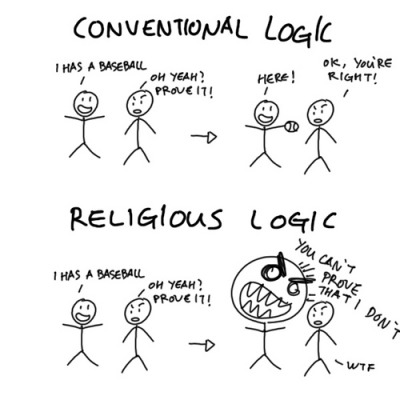
Given the stark differences in methodology of the two, it's hard to see how one can be a scientist, and religious at the same time.
Some people say that religion and science are two different concepts, seeking to explain two different things. I tend to disagree. Religion often makes claims that fall smack-bang in the arena of science.
The virgin birth, for example. That is a biological claim.
The making of water into wine. A physical claim.
The resurrection of Jesus. A biological claim.
The making of humans from mud/clay. A biological claim.
All that are completely unsupported by science. If a scientist, in a scientific conference, were to make such claims, she/he would be laughed out of the room.. but somehow, when a scientist makes such a claim in general, we are expected to be respectful and understanding.
But okay, let's say that you don't agree with literal readings of the holy books, that you only look to religion for moral guidance.
Well, you couldn't have found a worse guide to morality. The old holy books are chock full of racism, misogyny, slavery, child abuse, animal cruelty, genocide, rape, and any number of horrors you care to imagine.
Now, most people nowadays (in the western world, at least) simply disregard the parts of the bible that display these horrors as 'metaphorical'.
Personally, I fail to see how giving up one's daughters to be raped by a horde of angry men in the stead of a couple of 'angels' is a metaphor for anything but utmost misogyny. Why did Lot not give himself up to be raped and tortured, I wonder? But that's another matter, all I wish to display is that continued human discussion and rationality is a more reliable source of morality than an ancient text.
Here's the main thing that I do not understand. We all have criteria for belief in anything. If I were to go up to somebody and tell them I can fly, they would ask for proof immediately, and dismiss me if I failed to provide any. A sentence like "You just have to have faith that I can!" would earn me some hearty belly-laughs.
This goes for everything in life. If somebody tells you that your mother has died, you'd want proof, you'd demand to know how they know. If somebody tells you your partner is cheating on you, you'd similarly want proof. Saying "have faith" just wouldn't fly in any of these situations, and their claims would be brushed aside with impatience.
An argument I've heard for this is that "Nobody knows how the universe was created, and you can't prove it wasn't god, so my view is just as valid as yours!".
At this juncture, I point out the FSM, the Celestial Teapot, and the Invisible Pink Unicorn. Nobody can 'disprove' any of these, yet is that a good reason to start believing them?


Tidak ada komentar:
Posting Komentar